






Choosing the right Tweeter is an important part of Speaker design. Different Tweeter types have different characteristics in terms of frequency response, sensitivity, dispersion, power handling, and application. Therefore, the best tweeter depends on the requirements of the complete audio system.
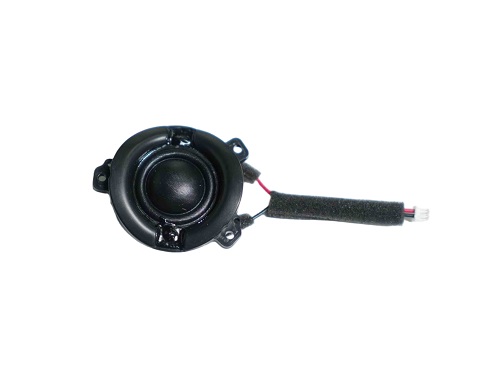
What Are the Main Types of Tweeters?
Common tweeter designs include dome tweeters, ribbon tweeters, horn tweeters, and Air Motion Transformer (AMT) tweeters. Each design uses a different diaphragm and acoustic structure to reproduce high-frequency sound.
1. Dome Tweeters
Dome tweeters are widely used because they offer a practical balance between frequency response, dispersion, sensitivity, and manufacturing cost.
They can be designed with different diaphragm materials, including fabric, polymer, and metal. This makes dome tweeters suitable for a wide range of home, commercial, and professional speaker systems.
2. Ribbon Tweeters
Ribbon tweeters use a thin conductive diaphragm placed within a magnetic field. Their low moving mass allows them to respond rapidly to high-frequency signals.
They are often considered for applications where detailed high-frequency reproduction and fast transient response are important.
3. Horn Tweeters
Horn tweeters use a horn structure to improve acoustic loading and directivity. They can achieve high sensitivity and strong acoustic output, making them suitable for professional audio and public address systems.
The horn geometry can also be designed to control the dispersion pattern according to the requirements of the speaker system.
4. AMT Tweeters
Air Motion Transformer tweeters use a folded diaphragm to move air efficiently. Their design can provide fast transient response and controlled high-frequency dispersion.
AMT tweeters are commonly considered for high-performance audio systems where detailed high-frequency reproduction is required.
Which Tweeter Is Best for Your Application?
| Tweeter Type | Key Strength | Suitable Applications |
|---|---|---|
| Dome Tweeter | Balanced performance and versatility | Home, commercial, and professional speakers |
| Ribbon Tweeter | Fast response and high-frequency detail | Hi-Fi and high-performance audio |
| Horn Tweeter | High sensitivity and strong output | PA and professional audio |
| AMT Tweeter | Fast response and controlled dispersion | High-end and professional audio |
What Should You Consider When Choosing a Tweeter?
Instead of choosing a tweeter based only on its type, speaker manufacturers should evaluate the specifications that directly affect system performance.
Frequency Response
The tweeter should provide an appropriate frequency range and integrate smoothly with the Woofer or midrange driver through the crossover network.
Sensitivity
Sensitivity indicates how efficiently the tweeter converts electrical power into acoustic output. The sensitivity should be compatible with the other drivers in the speaker system.
Power Handling
The tweeter must be able to handle the expected power level without excessive thermal or mechanical stress. This is especially important for professional and high-output speaker systems.
Dispersion
Dispersion determines how high-frequency sound spreads throughout the listening area. The appropriate dispersion pattern depends on the speaker enclosure, room, installation position, and intended application.
Impedance
Impedance should be compatible with the amplifier and the overall electrical design of the speaker system.
Why Is Tweeter Matching Important?
A tweeter does not work independently. Its performance is closely related to the woofer, midrange driver, crossover, enclosure, amplifier, and acoustic environment.
For this reason, the best tweeter is not necessarily the one with the highest specifications. It is the tweeter that provides the right combination of acoustic and electrical performance for the complete speaker system.
Custom Tweeter Solutions for Speaker Manufacturers
For OEM and ODM speaker projects, tweeter specifications can be developed according to the requirements of the final product. Frequency response, impedance, sensitivity, power handling, dimensions, materials, and dispersion can all be considered during the product development process.
Roxound is a professional loudspeaker manufacturer with extensive R&D and production capabilities. Our automated magnetic circuit assembly and multiple production lines support customized loudspeaker manufacturing for global B2B customers.
Conclusion
There is no single tweeter type that is best for every application. Dome, ribbon, horn, and AMT tweeters each offer different advantages.
The right choice should be based on the required frequency response, sensitivity, power handling, dispersion, impedance, enclosure design, and target application. For speaker manufacturers, matching the tweeter with the complete acoustic system is the key to achieving consistent performance.