






Powerful Bass is one of the most important characteristics of a high-performance audio system, but strong low-frequency output does not come from Speaker size alone. A Woofer speaker produces bass through the coordinated movement of its cone, motor, suspension, and other components, while the enclosure and amplifier also have a major influence on the final result.
For audio equipment manufacturers and professional audio system designers, understanding these factors makes it easier to select or develop a Woofer speaker that delivers strong, controlled, and consistent low-frequency performance.
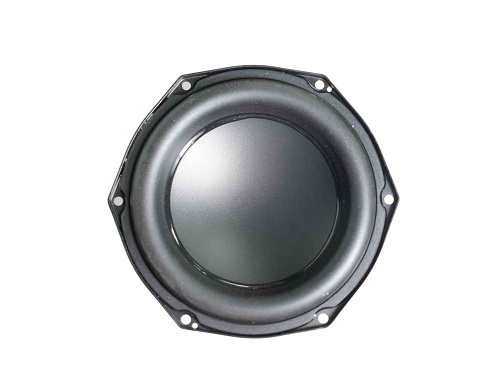
1. Cone Design Controls Air Movement
The speaker cone converts the mechanical movement of the voice coil into air movement, creating sound waves. Its diameter, material, stiffness, weight, and construction all affect how the woofer responds to low-frequency signals.
A well-designed cone needs to balance rigidity and controlled movement. If the cone is too flexible, unwanted deformation can affect sound quality. If it is unnecessarily heavy, it may require more energy to achieve the desired movement.
Different applications therefore use different cone materials and construction methods to achieve the required combination of bass response, efficiency, durability, and sound characteristics.
2. Motor Structure Provides the Driving Force
The motor structure is responsible for converting electrical energy into mechanical movement. The voice coil interacts with the magnetic field to move the cone forward and backward according to the audio signal.
A well-engineered magnetic and voice-coil system can provide stable driving force and controlled cone movement. This is particularly important when the woofer speaker operates at higher output levels.
For professional audio applications, the motor structure should be evaluated together with the speaker's power handling and excursion requirements rather than viewed as a separate specification.
3. Cone Excursion Affects Bass Output
Low-frequency reproduction requires the speaker cone to move a significant amount of air. Excursion describes how far the cone moves from its resting position.
When a woofer speaker can achieve appropriate excursion while maintaining controlled movement, it can generate strong low-frequency output without excessive distortion. However, greater excursion alone does not guarantee better bass. The motor structure, suspension, cone design, and enclosure must all support the required movement.
4. Woofer Size Influences Air Displacement
Woofer size is closely related to the amount of air the speaker can move. A larger cone can displace more air with the same general movement, which is one reason larger woofer speakers are commonly used in systems requiring high bass output.
Nevertheless, physical size needs to match the application. Compact products may require smaller woofers with optimized motor and suspension designs, while professional systems may have sufficient cabinet volume for larger drivers.
The objective is not simply to select the largest woofer available, but to choose a driver that matches the required acoustic output and enclosure design.
5. The Suspension Keeps Cone Movement Controlled
The surround and spider form an important part of the woofer's suspension system. They help keep the voice coil and cone aligned while allowing the required forward and backward movement.
A properly designed suspension contributes to controlled excursion, mechanical stability, and consistent performance. It also helps the woofer return to its correct resting position after movement.
For applications involving frequent high-output operation, suspension durability can be especially important for maintaining long-term performance.
6. Power Handling Supports High-Level Bass Output
Power handling determines how much electrical energy the woofer speaker can accommodate under specified conditions. Powerful bass often requires substantial cone movement, which means the speaker must be able to handle the associated electrical and mechanical demands.
However, simply increasing the power rating is not enough. The voice coil, magnetic structure, cooling design, cone, suspension, and enclosure must work together to support higher output levels.
This is why professional woofer speaker design considers thermal and mechanical performance alongside the nominal power specification.
7. Enclosure Design Has a Major Acoustic Effect
Even a high-quality woofer speaker can perform differently depending on the enclosure in which it is installed. Cabinet volume, internal structure, port dimensions, and enclosure type all influence the resulting bass response.
A properly matched enclosure can help the woofer achieve the desired low-frequency extension and acoustic output. In contrast, an unsuitable enclosure may reduce bass performance or create unwanted peaks and distortion.
When developing an audio product, the woofer and enclosure should therefore be designed or selected as part of the same acoustic system.
8. Frequency Response Determines How Deep the Bass Goes
Powerful bass is not only about volume. The woofer speaker must also reproduce the low-frequency range required by the application.
A woofer designed for a particular frequency range may be optimized for different characteristics such as bass extension, output level, efficiency, or response control. The appropriate frequency response depends on whether the speaker is used in a multimedia system, professional audio equipment, home audio product, or another application.
9. Amplifier Matching Matters
The amplifier supplies the electrical signal and power required to drive the woofer speaker. An appropriate match between amplifier output and woofer characteristics helps the system operate efficiently and reduces the risk of unwanted distortion or excessive stress.
Impedance, power handling, sensitivity, and system configuration should all be considered when matching the woofer with an amplifier.
10. Powerful Bass Requires the Whole System to Work Together
The final bass performance of a woofer speaker is the result of multiple factors working together. Cone design determines how the diaphragm moves, the motor provides driving force, the suspension controls movement, and the enclosure shapes the acoustic response.
Amplifier matching and system tuning then determine how effectively these components perform together.
For this reason, a high-performance woofer speaker should be evaluated as part of a complete audio system rather than judged by a single specification such as diameter or wattage.
Powerful bass comes from a combination of effective air displacement, controlled cone excursion, motor strength, suspension design, power handling, enclosure matching, and appropriate system integration.
For OEM and professional audio applications, choosing the right woofer speaker requires a clear understanding of the target frequency range, output requirements, cabinet design, amplifier configuration, and operating environment.
Need a woofer speaker for a new audio product or system? Contact our team to discuss your application and speaker requirements, including OEM/ODM customization and bulk supply.