


News
CHECK IT NOW


2026-06-15 17:34:27
A Dome Tweeter is a specialized loudSpeaker driver designed to reproduce high-frequency sounds,typically ranging from 2 kHz to 20 kHz and beyond.It is commonly found in home audio systems,car audio speakers,studio monitors,and professional sound equipment.Its dome-shaped diaphragm enables accurate and detailed reproduction of Treble frequencies,making music sound clearer and more realistic.
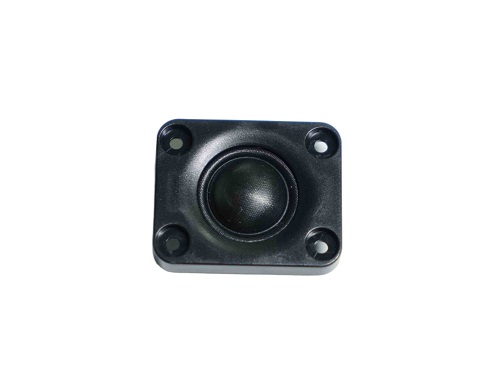
A dome tweeter works by converting electrical audio signals into sound waves through electromagnetic interaction.
When music or other audio content is played,an electrical signal is sent from the amplifier to the tweeter's voice coil.The voice coil is a lightweight wire wound around a cylindrical former and attached to the dome diaphragm.
The voice coil sits within a strong magnetic field created by a permanent magnet.As the audio signal flows through the coil,it generates a changing electromagnetic field.
This electromagnetic field interacts with the permanent magnet,causing the voice coil to move forward and backward rapidly.
Because the voice coil is attached directly to the dome diaphragm,the dome moves together with the coil.These rapid vibrations create pressure changes in the surrounding air.
The movement occurs thousands of times per second,allowing the tweeter to reproduce delicate high-frequency details such as:
Cymbal crashes
Violin harmonics
Female vocals
Acoustic guitar overtones
Ambient sound effects
As the dome vibrates,it generates sound waves that travel through the air to the listener's ears.The shape of the dome helps distribute these high frequencies over a wide listening area,resulting in excellent sound dispersion and a larger sweet spot.
The diaphragm is the primary sound-producing element.
Common materials include:
Silk
Textile fabric
Aluminum
Titanium
Magnesium
Beryllium
The material influences the tweeter's tonal character,efficiency,and frequency response.
The voice coil converts electrical energy into mechanical movement.Because high frequencies require extremely fast motion,the coil must be lightweight and precisely constructed.
The magnet creates the magnetic field necessary for operation.Stronger magnets generally improve sensitivity and control.
Common magnet materials include:
Ferrite
Neodymium
Suspension System
The suspension keeps the voice coil centered within the magnetic gap while allowing controlled movement.
Many dome tweeters use specially designed faceplates or waveguides to improve sound dispersion and frequency response.
The dome design offers several advantages over other tweeter shapes.
A dome radiates sound evenly in multiple directions,allowing listeners to enjoy consistent audio quality even when seated off-axis.
The small,lightweight dome can accelerate and stop very quickly,which is essential for reproducing high-frequency signals accurately.
The curved structure helps maintain rigidity during operation,reducing unwanted resonances and distortion.
Dome tweeters generally provide a balanced and natural treble presentation,making them popular in Hi-Fi systems.
Soft dome tweeters are typically made from silk or treated fabrics.
Warm and smooth sound
Less listening fatigue
Wide dispersion
Natural vocal reproduction
Home theater systems
Studio monitors
Hard dome tweeters use metal materials such as aluminum,titanium,or beryllium.
Higher sensitivity
Extended high-frequency response
Excellent detail and clarity
Greater dynamic capability
Premium home audio
Professional monitoring
Car audio systems
| Feature | Dome Tweeter | Cone Tweeter |
|---|---|---|
| High-Frequency Detail | Excellent | Moderate |
| Dispersion | Wide | Narrower |
| Sound Quality | More Accurate | Less Refined |
| Common Applications | Hi-Fi Audio | Budget Speakers |
| Feature | Dome Tweeter | Horn Tweeter |
|---|---|---|
| Sound Character | Smooth | Powerful |
| Efficiency | Moderate | High |
| Coverage | Wide | Directional |
| Usage | Home Audio | PA Systems |
| Feature | Dome Tweeter | Ribbon Tweeter |
|---|---|---|
| Cost | Moderate | Higher |
| Durability | High | Lower |
| Detail Retrieval | Excellent | Exceptional |
| Power Handling | Better | Lower |
Accurate high-frequency reproduction
Wide sound dispersion
Compact design
Low distortion
Good power handling
Cost-effective manufacturing
Suitable for both home and professional audio systems
Dome tweeters are widely used in:
Home theater speakers
Bookshelf speakers
Floor-standing speakers
Studio monitors
Car audio systems
Conference room audio systems
Multimedia speakers
Most dome tweeters operate from approximately 2,000 Hz to 20,000 Hz,although some premium models can extend beyond 30,000 Hz.
Silk dome tweeters provide a smooth and natural treble response that many listeners find comfortable for long listening sessions.
Not necessarily.Metal dome tweeters often offer greater detail and sensitivity,while silk domes typically provide a warmer sound.The best choice depends on the application and listener preference.
Yes.A crossover network directs high-frequency signals to the tweeter and prevents damaging low-frequency energy from reaching it.
Copyright © 2026 Jiangxi ROXOUND Acoustic Technology Co. All rights reserved.


Privacy Policy Cookie Policy Terms and Conditions